Every nurse enters the profession for one reason: to care for people.
Yet in healthcare systems around the world, nurses often spend a significant portion of their day completing documentation, updating records, and handling administrative tasks.
While documentation is essential for patient safety and continuity of care, it can also take valuable time away from direct patient interactions.
Recently, the BorderPlus team traveled across Germany to better understand these realities firsthand.
What they discovered reinforced an important lesson:
The future of healthcare isn’t just about better technology. It’s about giving nurses more time to be nurses.
Going Beyond the Office: Meeting Nurses Where They Work
At BorderPlus, building solutions for healthcare professionals starts with listening.
That is why our team spent time visiting healthcare facilities, speaking directly with nurses, observing workflows, and learning about the challenges they face every day.
The visits were led by BorderPlus’ Field Discovery Engineers (FDEs).
What Are Field Discovery Engineers (FDEs)?
Field Discovery Engineers are team members who spend time directly in healthcare environments to understand how work actually happens on the ground.
Rather than making assumptions from behind a desk, FDEs:
- Visit healthcare facilities
- Observe nursing workflows
- Speak with healthcare professionals
- Identify operational challenges
- Understand documentation processes
- Gather insights for improving healthcare technology
Their role is simple but important:
Listen first. Build second.
By understanding the daily realities of nursing, BorderPlus can create tools and learning experiences that genuinely support healthcare professionals.
What Did the Team Observe?
One theme emerged consistently during conversations with nurses across Germany.
Administrative Work Takes Time
Nurses are responsible for much more than patient care alone.
Throughout a typical shift, they often need to:
- Complete patient documentation
- Update care records
- Record observations
- Manage compliance requirements
- Communicate across teams
- Track medications and treatments
All of these tasks are essential.
However, they also consume a significant amount of time.
Many nurses described the challenge of balancing administrative responsibilities with the desire to spend more time with patients.
The Documentation Burden Is Real
Healthcare documentation serves an important purpose.
It helps ensure:
- Patient safety
- Care continuity
- Legal compliance
- Communication between healthcare teams
But when documentation becomes overly complex or time-consuming, it can add pressure to already demanding nursing roles.
The BorderPlus team observed that nurses are constantly looking for ways to simplify routine administrative tasks without compromising quality or accuracy.
And this is where technology can make a meaningful difference.
During one conversation, a nurse described an efficient digital workflow with a simple phrase:
“You just press it, boom, done.”
That sentence perfectly captured what healthcare technology should achieve.
Technology should not create additional work.
It should remove unnecessary friction.
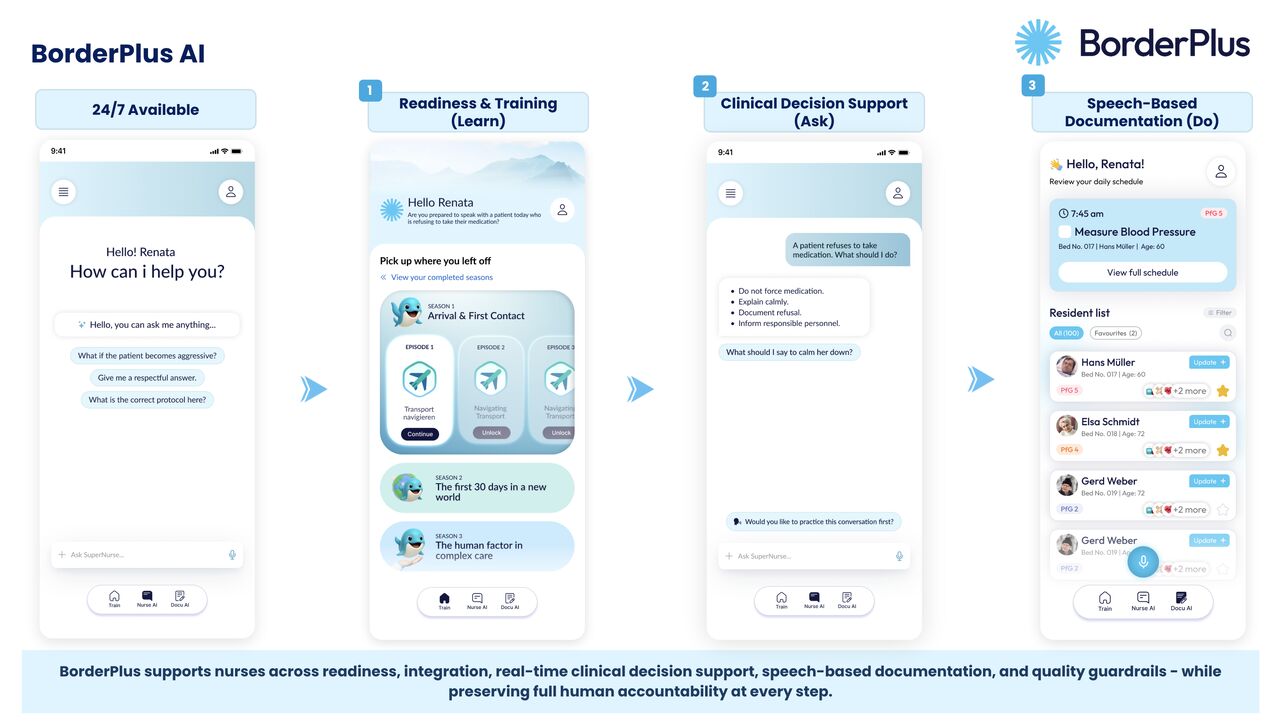
The best tools are often the simplest ones—the ones that help nurses complete tasks quickly, confidently, and accurately so they can focus on patient care.
For BorderPlus, this became one of the most memorable insights from the field visits.
Because ultimately, healthcare innovation is not about technology itself.
It is about making life easier for the people who use it every day.
Why Simplicity Matters in Healthcare
Healthcare environments are fast-paced and demanding.
Nurses make important decisions throughout their shifts while managing multiple responsibilities at once.
In these settings, every extra step matters.
Solutions that reduce complexity can help:
- Save time
- Improve efficiency
- Reduce stress
- Enhance communication
- Support better patient experiences
When processes become simpler, nurses gain more opportunities to focus on what matters most—patients.
Learning Directly from the Frontline
One of the biggest takeaways from the Germany visits was that the best ideas often come directly from healthcare professionals themselves.
Nurses understand their challenges better than anyone.
Their insights reveal:
- Workflow bottlenecks
- Documentation frustrations
- Communication gaps
- Opportunities for improvement
- Practical solutions that actually work
This is why direct engagement remains a core part of the BorderPlus approach.
Listening to nurses helps ensure that future innovations are grounded in real-world needs rather than assumptions.
Building a Better Future for Nurses
Healthcare systems worldwide continue to face challenges such as:
- Growing patient populations
- Workforce shortages
- Increased administrative demands
- Rising documentation requirements
Technology alone cannot solve these issues.
However, thoughtfully designed tools can help reduce unnecessary burdens and support healthcare professionals in meaningful ways.
The goal is not to replace nurses.
The goal is to empower them.
To help them spend less time navigating paperwork and more time doing what they entered the profession to do: caring for patients.
What Comes Next?
The observations gathered by BorderPlus Field Discovery Engineers will continue to shape how we support healthcare professionals preparing for careers in Germany.
Every conversation, every workflow observation, and every nurse’s perspective helps us better understand the realities of modern healthcare.
And sometimes, the most powerful insight comes from a simple phrase:
“You just press it, boom, done.”
That is the standard every healthcare innovation should strive for.
Simple. Helpful. Effective.
And always focused on supporting the people who care for others.
Supporting Nurses Every Step of the Way
At BorderPlus, our mission is to help nurses build successful international healthcare careers through training, preparation, guidance, and innovation.
By learning directly from healthcare professionals across Germany, we continue to create pathways that support nurses both before and after they begin their international journey.
Because the future of healthcare starts with understanding the people who make it possible.

Stay informed with expert insights, career tips, and industry updates on global healthcare mobility.