Matcha meets Masala. Skills meet opportunity.
India and Japan are entering an important new phase of cooperation around skills, talent development, and workforce mobility. As Japan continues to require skilled professionals across sectors and India has a large pool of young talent, the opportunity is not simply about helping people move across borders.
It is about making sure they are properly prepared to succeed once they get there.
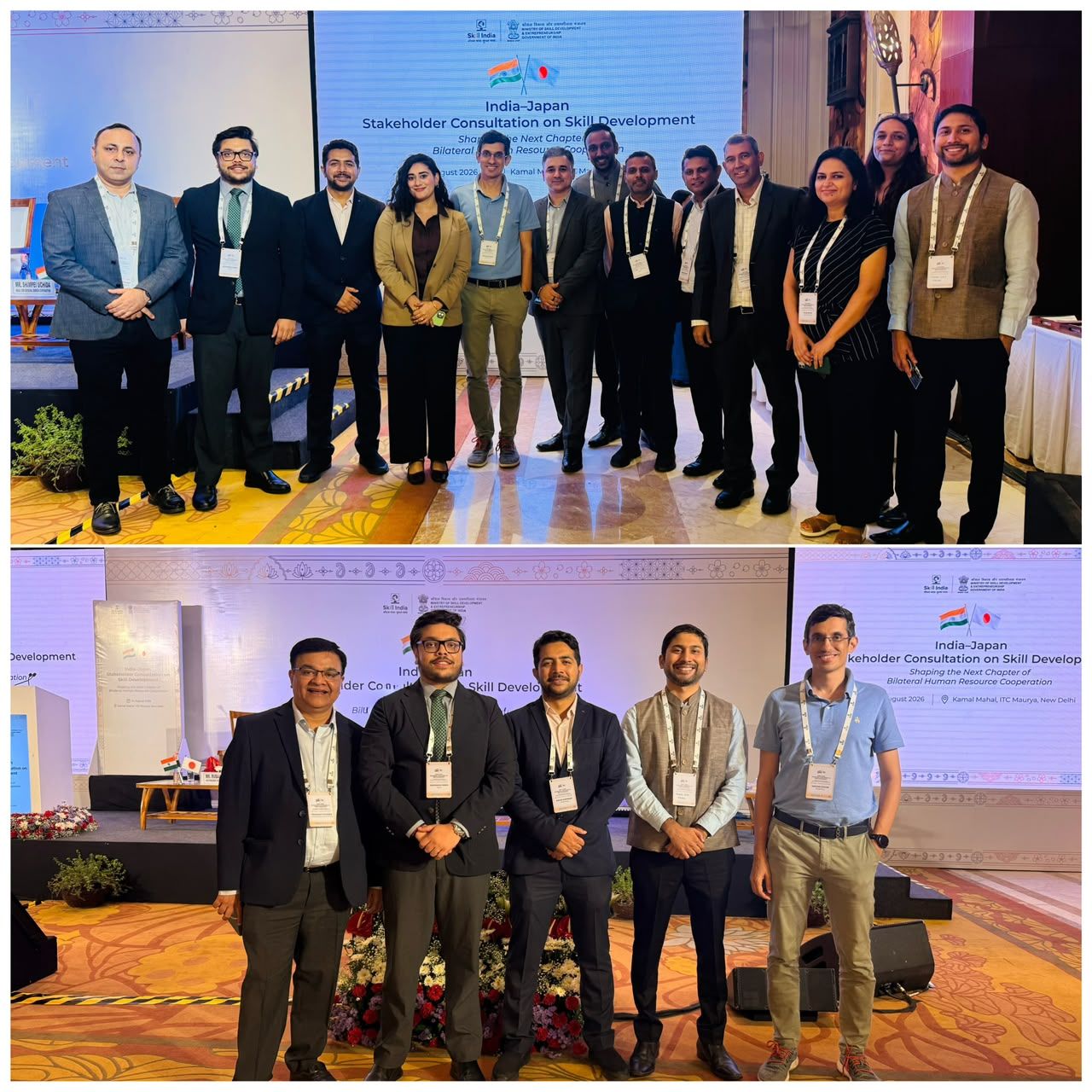
This idea was at the centre of the India-Japan Stakeholder Consultation on Skill Development, convened by the Ministry of Skill Development and Entrepreneurship (MSDE) on 14 August 2026 in New Delhi. The consultation brought together government representatives, industry, training institutions, Sending Organisations, recruitment stakeholders, and Japanese partners to discuss how India and Japan can strengthen pathways connecting Indian talent with opportunities in Japan.
From Moving People to Preparing Talent
International workforce mobility is often discussed in terms of how many people can move from one country to another.
But sustainable mobility requires much more than recruitment.
A candidate preparing to work in Japan needs the right combination of:
- Technical and domain-specific skills
- Japanese language proficiency
- Cultural understanding
- Workplace readiness
- Recognised assessments
- Confidence to work in a new environment
- Awareness of the expectations of Japanese employers
The consultation placed this broader idea at the centre of India-Japan cooperation.
The objective is to build pathways where skills meet industry demand, language meets opportunity, and talent has the confidence to succeed.
Why India and Japan Are Strengthening Workforce Cooperation
India and Japan have complementary strengths.
India has a large and young talent pool, while Japan has growing demand for skilled human resources across areas affected by workforce shortages.
This creates an opportunity to build stronger connections between:
Indian talent → Skills → Japanese employers → Global careers
The Japanese Ambassador to India, H.E. Mr. Ono Keiichi, highlighted the importance of connecting Japan’s demand for skilled human resources with India’s young talent pool through appropriate skills development, Japanese language training, and reliable employment pathways.
The focus is therefore shifting toward creating structured systems that can prepare Indian professionals for the realities of working and living in Japan.
Taking the India-Japan Human Resource Action Plan Forward
The consultation also focused on taking forward the Action Plan for India-Japan Human Resource Exchange and Cooperation, which was jointly released during the 15th India-Japan Annual Summit in 2025.
The Action Plan provides a broader framework for strengthening cooperation around human resource development and mobility.
The next challenge is implementation.
That means turning broad objectives into practical pathways covering:
- Candidate mobilisation
- Skills development
- Japanese language training
- Cultural preparation
- Assessments
- Employer engagement
- Pre-departure preparation
- Candidate support
The consultation was an important step toward translating that cooperation into coordinated action.
Moving Beyond Traditional Mobility Pathways
One of the key areas of discussion was how existing and emerging workforce pathways can work together.
The consultation examined:
Technical Intern Training Programme (TITP)
TITP has provided an established pathway for Indian talent to gain work experience in Japan.
The discussion focused on its existing implementation structures and areas where learnings can support future pathways.
Specified Skilled Worker (SSW)
The SSW framework provides opportunities for skilled foreign workers across sectors where Japan has workforce requirements.
Strengthening preparation for these pathways requires candidates to have the right combination of occupational skills and language capability.
Employment for Skill Development Programme (ESDP)
The upcoming Employment for Skill Development Programme (ESDP) was another major focus.
The consultation examined how ESDP can be developed and how it can converge effectively with existing pathways such as TITP and SSW.
Together, these pathways can contribute to a more structured approach to preparing Indian talent for Japanese employment.
The Importance of Japanese Language and Cultural Preparation
Technical skills alone cannot guarantee success in an international workplace.
Language plays an essential role in helping professionals:
- Communicate with colleagues
- Understand workplace instructions
- Interact with customers and patients
- Follow professional processes
- Build relationships
- Adapt to everyday life
Cultural preparation is equally important.
Professionals moving to Japan need to understand workplace expectations, communication styles, professional behaviour, and the environment in which they will work.
The consultation therefore placed Japanese language and cultural preparation alongside technical skills as a core part of workforce readiness.
Industry-Aligned Skills: Preparing for Real Employer Demand
Another important focus was making training more closely connected to what employers actually need.
A qualification alone does not necessarily mean that a candidate is ready for a specific international job.
Training needs to reflect:
- Occupational requirements
- Industry expectations
- Destination-specific skills
- Language proficiency
- Workplace behaviour
- Employer expectations
Japanese employers and recruitment organisations participated in discussions around these requirements, bringing industry perspectives directly into the conversation.
This creates a stronger connection between what candidates learn and what employers need.
Three Key Areas Shaping the India-Japan Skills Pathway
The consultation brought together different aspects of workforce mobility through three broad areas of discussion.
Existing and Emerging Skilling Pathways
The first area examined TITP, SSW, and ESDP, with discussions around implementation, convergence, and readiness for the upcoming ESDP.
The goal is to create greater clarity around how these pathways can work together.
Human Resource Exchange and Preparation
The second area focused on the broader Human Resource Exchange Action Plan.
Discussions included:
- Expanding Japanese language training
- Sector-specific curricula
- Assessment access
- Stronger coordination between institutions
- Better preparation for international employment
Direct Employer and Recruitment Engagement
The third area brought Japanese recruitment companies and employers into direct discussions with Indian stakeholders.
This allowed the conversation to move from policy-level objectives toward practical employer requirements.
Key areas included:
- Occupational skills
- Japanese language proficiency
- Workplace readiness
- Candidate support
- Alignment with current industry demand
Together, these discussions helped identify what needs to be strengthened to create effective India-Japan workforce pathways.
The Role of Government, Industry and Training Institutions
A strong international talent pathway cannot be created by one organisation alone.
It requires collaboration between:
- Central government ministries
- State governments
- Japanese government representatives
- Training institutions
- Sending Organisations
- Recruitment agencies
- Employers
- Industry bodies
- Skills development organisations
The consultation brought these different stakeholders together on one platform.
This collaborative approach is important because each stakeholder contributes a different part of the mobility ecosystem.
Government creates the framework.
Training institutions build capabilities.
Industry defines demand.
Employers provide opportunities.
Recruitment and Sending Organisations connect talent with those opportunities.
The candidate sits at the centre of all of it.
Jayant Chaudhary: Global Employability Requires More Than Technical Skills
The importance of preparing young Indians for international opportunities was emphasised by Shri Jayant Chaudhary, Minister of State (Independent Charge) for Skill Development and Entrepreneurship and Minister of State for Education.
The focus is not simply on creating overseas employment pathways.
Candidates need to have the:
- Relevant technical skills
- Language ability
- Confidence
- Workplace understanding
- Preparation required to succeed internationally
This changes the definition of employability.
Being employable globally means being prepared for the specific environment in which the skills will be used.
Debashree Mukherjee: Turning the Action Plan Into Implementation
Ms. Debashree Mukherjee, Secretary, MSDE, highlighted the importance of translating the India-Japan Human Resource Exchange Action Plan into coordinated implementation.
For that to happen, multiple elements need to work together:
- Candidate mobilisation
- Domain-specific skills
- Japanese language training
- Assessment systems
- Pre-departure preparation
- Employer demand
If these elements operate independently, candidates can face gaps between training and employment.
The goal is therefore to create better alignment across the entire pathway.
Abhishek Singh: Preparing Institutions for Industry-Aligned Skilling
Representing the industry perspective, Abhishek Singh, COO of Learnet and GSMAI Founding Member, contributed to the discussion around institutional preparedness and industry-aligned skilling.
This highlights another important part of global mobility.
It is not enough for individual candidates to become prepared.
Institutions themselves must also be ready.
Training providers need to understand:
- What employers require
- Which skills are in demand
- What language levels are expected
- How assessments should work
- How candidates should be prepared before departure
This creates a stronger connection between education, skills, and employment.
Towards an India-Japan Skills Roadmap
One of the most important outcomes of the consultation is the movement toward an India-Japan Skills Roadmap.
The roadmap is intended to create clearer direction around the skills and workforce pathways required for Japanese opportunities.
Rather than focusing only on immediate actions, the roadmap is expected to cover:
Short-Term Actions
Immediate priorities and operational improvements that can strengthen existing pathways.
Medium-Term Actions
Building stronger systems for training, assessments, employer engagement, and candidate preparation.
Long-Term Actions
Creating a more mature and sustainable India-Japan workforce mobility ecosystem.
The roadmap is also expected to include:
- Defined responsibilities
- Measurable milestones
- Governance mechanisms
- Review structures
- Coordination between stakeholders
This can help transform cooperation into measurable outcomes.
What Needs to Improve?
The consultation also brought several implementation priorities into focus.
Expand Japanese Language Training
More candidates need access to quality Japanese language preparation.
Strengthen Assessment Infrastructure
Candidates need access to reliable and recognised assessment systems.
Improve Awareness of Verified Pathways
Young professionals need clearer information about legitimate routes to employment in Japan.
Strengthen Stakeholder Coordination
Government departments, States, Sending Organisations, training institutions, and employers need to work more closely together.
Align Training With Employer Requirements
Training must reflect the actual skills, language proficiency, and workplace readiness expected by Japanese employers.
These improvements can make the journey from training to employment more effective and transparent.
Why Recruitment Alone Isn’t Enough
A talent bridge is not built simply by recruiting people.
Recruitment can connect a candidate with an opportunity, but preparation determines whether that candidate can succeed once they arrive.
A stronger model looks like this:
Skills → Language → Assessment → Workplace Readiness → Employer Demand → Opportunity
Each element reinforces the next.
This is particularly important when candidates are moving to a country with a different language, culture, workplace environment, and professional expectations.
From Matcha and Masala to Skills and Mobility
India and Japan may have very different cultures, languages, and traditions.
But there is growing common ground in the way both countries can approach future workforce development.
The shared opportunity is to create a system where Indian talent is:
- Skilled
- Confident
- Language-ready
- Culturally prepared
- Professionally equipped
- Connected to genuine employer demand
That is how workforce mobility can become more than movement between two countries.
It can become a long-term talent partnership.
Building a Future-Ready India-Japan Workforce
The India-Japan Stakeholder Consultation on Skill Development represents an important step toward creating stronger global career pathways for Indian talent.
The focus is moving from simply asking:
“How do we move more people?”
to a more important question:
“How do we prepare more people to succeed?”
The answer lies in bringing together:
- Industry-aligned skills
- Japanese language proficiency
- Cultural preparation
- Recognised assessments
- Employer engagement
- Candidate support
- Pre-departure readiness
- Strong institutional coordination
With a proposed India-Japan Skills Roadmap providing direction, the next phase can focus on turning these priorities into practical, measurable action.
The Future of India-Japan Talent Mobility
India has the talent.
Japan has significant demand for skilled professionals.
The opportunity lies in building the bridge between them.
That bridge cannot be built through recruitment alone. It needs skills that meet industry demand, language that meets opportunity, and preparation that gives talent the confidence to succeed.
From Matcha to Masala, the flavours may be different—but when it comes to skills and opportunity, India and Japan have increasingly strong common ground.
The next chapter is about turning that common ground into structured, industry-aligned and future-ready global career pathways.

Stay informed with expert insights, career tips, and industry updates on global healthcare mobility.