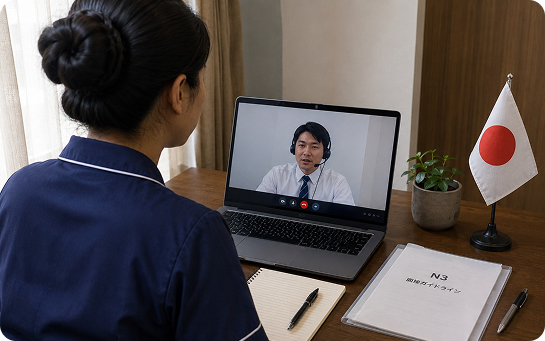
Start with a short interview with the BorderPlus team to check if you qualify for the BorderPlus Finishing School.
At the Finishing school you will learn
 4 weeks online + 25 weeks in the classroom
Japanese from N5 to N3
Everyday Japanese, medical Japanese & caregiving terminology for care home related work
4 weeks online + 25 weeks in the classroom
Japanese from N5 to N3
Everyday Japanese, medical Japanese & caregiving terminology for care home related work
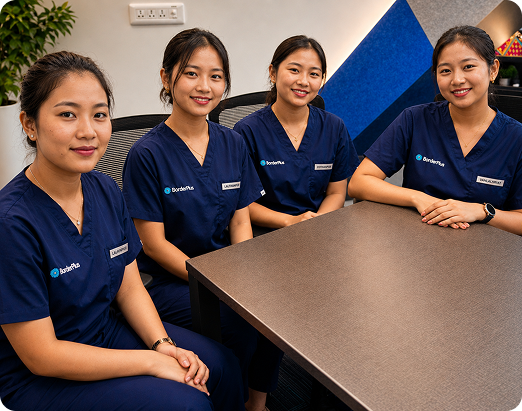
Once you complete your N4 training, BorderPlus connects you to top Japanese recruiters; offer letter after you finish N3 while placement and visa is processed.
Direct access to leading Japanese care homes & recruiters
Interview opportunities through BorderPlus
Smooth transition from language training to job placement
BorderPlus takes care of your CoE (Certificate of Eligibility) Application to the Japan Immigration Desk.
Once CoE is confirmed, the SSW Visa is applied
Flight Tickets & Visa entirely sponsored
Local Team in Japan to help you settle
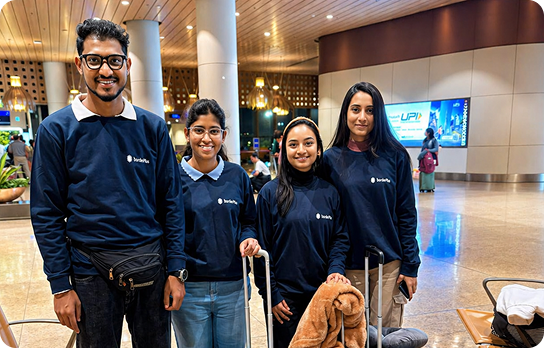
After arriving our local team in Japan will help you find housing, bank account, SIM card, travel arrangements etc. to start your life in Japan.
Orientation Program is conducted to guide you
Support Desk available to resolve any queries and issues across the entire 5 years
Further learning opportunities available to further improve language, caregiving skills and become
ready to clear Caregiver Entrance Exam (Kaigo Fukushishi) after 3 years
Upfront as deposit money
₹ 50,000 in 5 months
(10k on online enrollment & 90k on offline)
Pay in installments
 No Japan language training
No Visa & Documentation assistance
No Post landing support
No cultural & caregiving training support
No software support
No Japan language training
No Visa & Documentation assistance
No Post landing support
No cultural & caregiving training support
No software support

 30 weeks of Japanese language training at our Finishing school
Complete Visa & Documentation assistance
Full support for 5 years
Comprehensive cultural & caregiving training by nursing educators
AI-enabled training 24x7 support
External Japanese language training at own arrangement
Limited assistance
No post landing support
Candidates asked to do self-study for caregiving exams
No software support
30 weeks of Japanese language training at our Finishing school
Complete Visa & Documentation assistance
Full support for 5 years
Comprehensive cultural & caregiving training by nursing educators
AI-enabled training 24x7 support
External Japanese language training at own arrangement
Limited assistance
No post landing support
Candidates asked to do self-study for caregiving exams
No software support
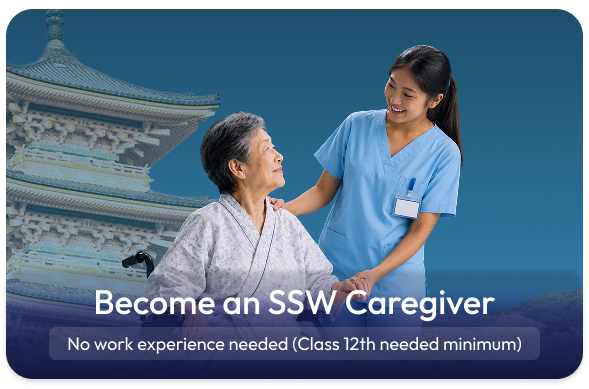
The Specified Skilled Worker (SSW) caregiver visa lets trained Indian caregivers work in Japan's elder-care sector for five years. BorderPlus trains you in Japanese and caregiving, arranges interviews with Japanese employers, and files your Certificate of Eligibility and visa paperwork.
You can apply if you are female, at least 18 years old, and have passed Class 12. You then complete KYC documents, a medical fitness check, and police verification, followed by a one-on-one interview about your motivation and fit for caregiving work. A nursing degree is not required.
Yes. The Japan caregiver route accepts candidates who have passed Class 12. You learn caregiving skills and Japanese during the training program. The Germany route is the one that requires a nursing qualification.
A caregiver in Japan starts at around ₹1.2 to ₹1.5 lakh per month, roughly ¥200,000 as a base salary before overtime and night-shift allowances. You also get paid annual leave and a regulated working week of about 40 hours.
The visa requires JLPT N4, or the equivalent JFT-Basic, tested by Prometric. BorderPlus trains you past that minimum, from beginner N5 up to N3, so you settle in faster at work and in daily life.
The program runs 29 weeks. You start with 4 weeks online, then move to 25 weeks of residential classroom training at a BorderPlus Finishing School. It covers Japanese from N5 to N3, medical and caregiving vocabulary, Japanese workplace culture, and interview practice.
BorderPlus runs Finishing School centres in Pune, Kochi, Bangalore, Hyderabad, and Noida. A Guwahati centre is under discussion. The first Japan batches run from the Pune centre.
The program costs ₹3,00,000 in total. You pay a ₹1,00,000 deposit first, split as ₹10,000 when you enroll online and ₹90,000 when you join offline. The remaining ₹2,00,000 training fee is payable in installments. Skill loans and scholarships are available, and you receive ₹10,000 a month as a stipend through the five months of offline training.
You earn two certificates recognised under Japan's MOFA and MOJ framework: the JLPT N4 or JFT-Basic Japanese proficiency certificate, and the SSW Caregiving (Kaigo) Skills Evaluation certificate. You need both to get the SSW visa
Plan for 9 to 11 months from enrollment to your first day at work in Japan. That covers about 6 months of training and 3 to 5 months for the Certificate of Eligibility, visa, and documents. The visa timing shifts depending on the prefecture.
No. There is no legal placement guarantee. BorderPlus accepts about 1 in 100 applicants and arranges at least two employer interviews for each candidate after training. The placement rate above 80% on record comes from the Germany program. Japan has no track record yet because placements have not started.
Japan's SSW rules require 10 support duties, handled by licensed local partners. These cover airport pickup, finding a home, opening a bank account, phone and utility setup, city-hall registration, orientation, ongoing consultation, help switching jobs if you are laid off, and regular three-way check-ins between you, your employer, and the support manager. Support runs for the full five years.
The SSW caregiver visa lasts 5 years. After about three years of work, you can sit Japan's national Certified Care Worker exam, the Kaigo Fukushishi, which opens a longer-term path in the field.
Japan is short about 250,000 caregivers in fiscal 2026, a gap set to reach 570,000 by 2040. Almost 30% of the population is 65 or older. Few Indian caregivers work there today, so Japanese employers are looking for trained candidates from India.
Germany hires qualified nurses, asks for B2 German, pays around ₹3.5 lakh a month, and has signed employers with 340+ placements behind it. Japan hires caregivers, asks for JLPT N4, pays around ₹1.2 to ₹1.5 lakh a month, and is a newer route open to Class 12 graduates. Pick based on your qualification and which language you would rather learn.